Blog
Market Insights
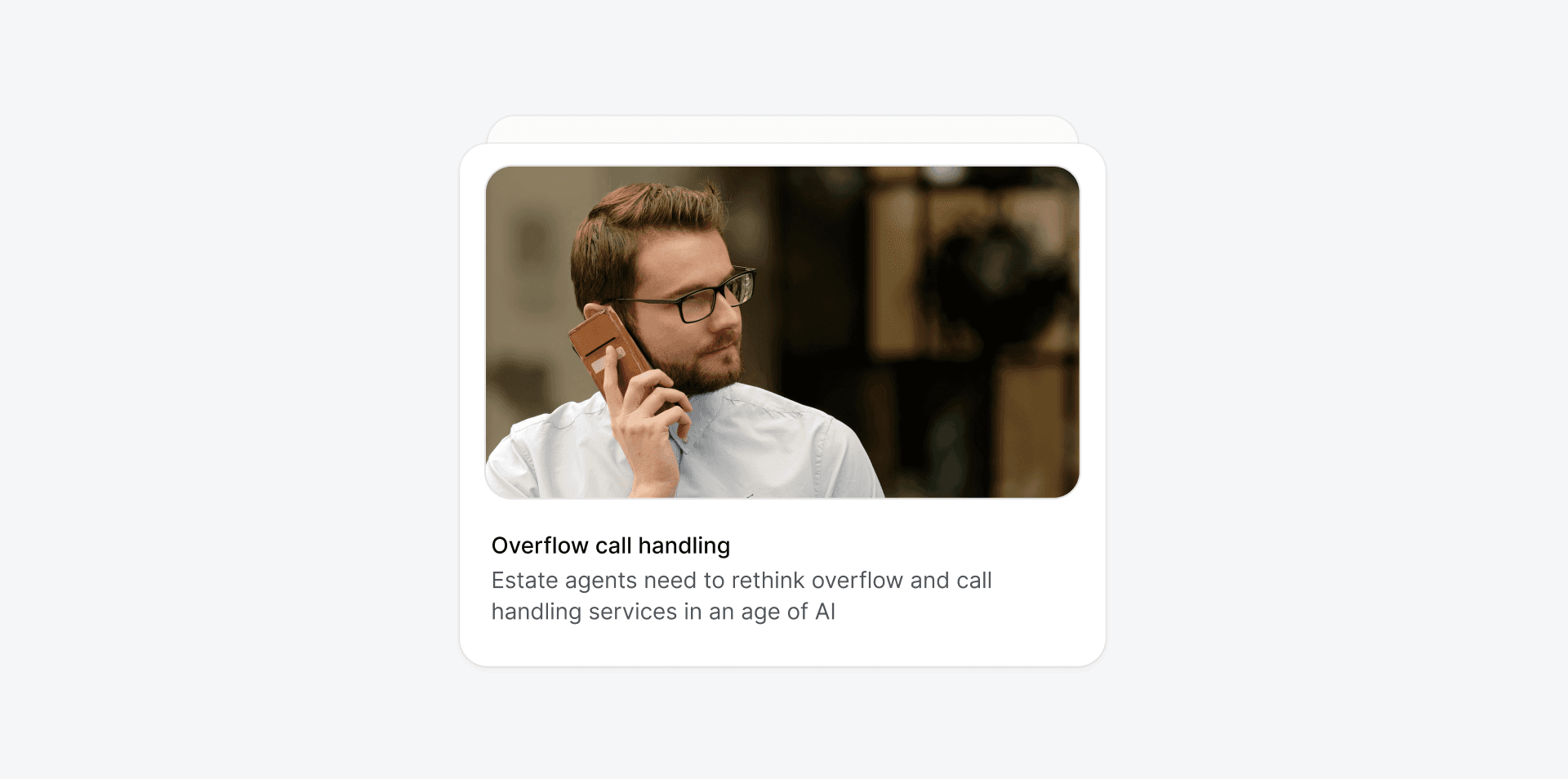
Estate agents need to rethink overflow and call handling in an age of AI
For years, overflow and call handling services have been the go-to solution for estate and letting agents who can't get to the phone. That is about to change.

Morgan Edmondson
Founder & CEO
For years, overflow and call handling services have been the go-to solution for estate and letting agents who can't get to the phone. You're mid-valuation, showing a buyer around, or out-of-office - someone needs to pick up the phone, so you outsource it.
The problem is that these services were never designed to do what agents actually need. They were designed to to take messages, and in 2025, that's no longer good enough.
The limitations of traditional call handling
Overflow services operate a simple model. A person in a contact centre answers your phone, follows a basic script, takes a name and number, and emails you the details. That's it.
They don't know your available stock. They don't know which properties match the caller's needs. They don't know your local area, the school catchments, the transport links, or the nuances that buyers, tenants and vendors actually care out. They certainly don't have the skills or expertise to effectively qualify a viewing or valuation client on the spot.
What you get is a message. What the caller gets is nothing more than a dead end.
From the client's perspective, the experience is horrible. They've called because they're interested. They want answers, availability, next steps. Instead they get someone reading from a generic script who can't help them and promises a callback that might come hours later. By then, the momentum is gone and they've moved on to a different agent.
Message taking is not conversion
There's a big difference between capturing a lead and converting one. Traditional call handling captures. It logs details and passes them on. But it does nothing to move that lead forward.
In a market where speed matters, this gap is costly. The agent who responds first, qualifies properly, and books the viewing wins the instruction. The agent whose overflow service says "someone will call you back" loses it.
And yet agencies keep paying for these services because until now there hasn't been a viable alternative. You either answer every call yourself, hire more staff, or accept that some leads will slip through the cracks.
AI changes what's possible
Voice AI has reached a point where it can do what call centres never could. Not just answer the phone, but actually have a conversation. A real one. The kind your best negotiator would have.
Modern voice AI doesn't sound robotic or scripted. It speaks naturally, with pauses, with warmth, with the ability to listen and respond appropriately. Callers often don't realise they're speaking to AI because the experience feels human.
But unlike a human, it never has an off day. It never forgets the script. It never gets flustered when ten calls come in at once. And it works at 10pm on a Saturday just as effectively as 10am on a Monday.
AI performs like a team member
The real power of voice AI is that it can be trained on your agency specifically. Not a generic script, but your tone, your qualifying questions, your way of handling objections.
It knows your available stock and can discuss specific properties. It understands your local area and can answer questions about schools, amenities, and transport. It gathers the right information every time, whether that's a buyer's budget and timeline or a landlord looking for a management quote or a homeowner thinking about selling.
It asks the right questions in the right order, politely and effectively. It qualifies properly. And when the lead is ready, it books the viewing or valuation there and then.
This isn't about replacing your team. It's about giving every caller the experience of speaking to your best negotiator, even when your actual team is unavailable.
The client experience transforms
Think about what this means for the person calling. Instead of a message taker who can't help, they get someone who understands their needs, answers their questions, and moves them forward immediately.
A buyer calls at 7pm asking about a property. The AI confirms availability, asks about their situation, qualifies their budget and timeline, and books a viewing for the next day. By the time your negotiator arrives at the office the following morning, the appointment is already in the diary with full notes on the client's requirements.
A vendor calls on a Sunday afternoon to enquire about a valuation. The AI asks about their property, their motivation, their timeframe. It books a valuation slot for later that week and logs everything in your CRM. No callback required. No lead left waiting.
That's the difference between capturing and converting.
The economics make sense
Traditional overflow services charge per call or per minute. The more successful your marketing, the more you pay, and the quality stays the same. Training and consistency are your problem. Staff turnover at the call centre means you're constantly dealing with new voices who don't know your business.
AI works differently. You configure it once, train it on your best practices, and it scales instantly. Whether you receive five calls or fifty in an hour, the cost stays flat and the quality stays consistent. Every caller gets the same high standard experience.
Over time, the AI learns from every conversation. It gets sharper, more effective, more attuned to what works. Traditional services never improve. They just keep taking messages.
The industry is shifting... fast
Estate and letting agents who have adopted voice AI are already seeing the results. More viewings booked. More valuations in the diary. Fewer leads lost to slow response times. Better client experiences from the very first interaction.
Meanwhile, agencies still relying on overflow services are competing with one hand tied behind their back. They're paying for a solution that was built for a different era, when taking a message was considered good enough.
It's not good enough anymore. Clients expect more. The technology now exists to deliver more. And the agents who embrace it will win more instructions while their competitors are still waiting for callbacks.
The question isn't whether voice AI will become the standard for how agents handle calls. It's whether you'll make the switch now or wish you had done it sooner.
Morgan Edmondson
Founder & CEO
Share