Blog
Market Insights
AI call handling vs outsourced reception for estate and letting agents
Weighing up AI call handling against outsourced reception for your agency? Here's an honest comparison across cost, availability, consistency and property knowledge.

Morgan Edmondson
Founder & CEO
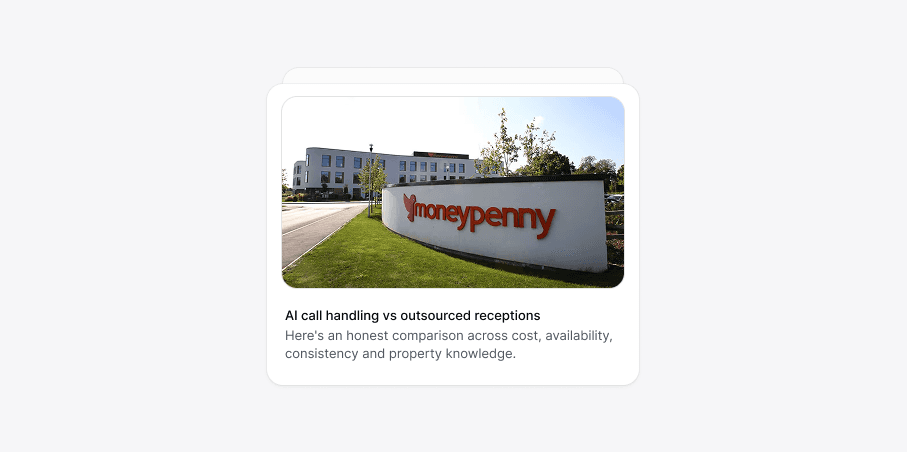
Outsourced reception has been a fixture in estate agency for years. The pitch is straightforward: a team of trained receptionists answers your calls when your negotiators are busy, out of the office, or off for the evening, and your callers get a human on the other end of the line. It works, to a point. But as AI call handling has matured specifically for the property sector, the comparison has become a more interesting one, and for a growing number of agencies, the maths has started to shift.
This isn't an argument that outsourced reception is bad. It's a proper look at what each option actually delivers, where each falls short, and how to think about the decision for your specific agency.
What Outsourced Reception Actually Looks Like
An outsourced reception service takes calls on behalf of your agency, usually during agreed hours, and either handles basic queries or takes a message and passes it on. The better services will have a script tailored to your agency, some knowledge of your team and your key properties, and a process for escalating calls that genuinely need a human negotiator.
The appeal is obvious. You get real people, which callers often prefer, and it's relatively straightforward to set up compared to integrating new technology into your workflow. For smaller agencies that have been operating this way for a long time, it feels familiar and manageable.
The limitations tend to show up in the gaps. Outsourced receptionists are typically working from a relatively thin briefing document, which means their knowledge of your listings, your processes, your referencing criteria, and your local market is limited. They take messages rather than resolving queries. They're available during contracted hours, not necessarily the hours when your callers most need someone to pick up. And the cost scales with call volume in a way that can start to feel significant once you do the numbers properly.
What AI Call Handling Looks Like
AI call handling platforms built for property take inbound calls, handle the conversation end to end, and deliver structured information to your team when the call is done. The AI can qualify callers, answer questions about specific listings, book viewings and valuations, forward calls when the situation genuinely needs a person, and log the whole interaction to your CRM automatically.
The meaningful difference between AI built for property and generic call handling tools is the level of knowledge the AI brings to the conversation. A platform like Nesti is trained on your listings, your local area, your fee structure, your processes, and your agency's tone before it answers a single call. The result is that callers are having a genuinely useful conversation rather than being told someone will call them back.
The practical advantages compound from there. AI operates around the clock without any additional cost for out-of-hours coverage. It handles five calls as easily as fifty. Every conversation is consistent, recorded, and summarised. And because it integrates directly with your CRM, your team starts every working day with a complete picture of what came in overnight rather than a voicemail box and a pile of pink message slips.
How They Compare Across What Matters Most
Availability
Outsourced reception is typically available during contracted hours, which may extend into evenings but rarely covers weekends and overnight in a meaningful way. AI is available every hour of every day without exception, and for most agencies, the highest-value missed calls happen outside office hours.
Property Knowledge
Even the best outsourced reception services can only work from what they've been given, and that briefing tends to be basic. AI trained specifically on your agency knows your current listings, your area, your processes, and the kinds of questions your callers ask, which means it can give genuinely useful answers rather than taking a message.
Cost
Outsourced reception is typically priced per call or per minute, and the costs are predictable but cumulative. AI call handling is usually priced on a subscription basis, which means the effective cost per call drops as volume increases and there's no additional charge for out-of-hours coverage.
Consistency
Every AI call is handled to the same standard, in the same tone, with the same depth of knowledge. Human receptionists vary by individual, by time of day, and by how well they've been briefed, and while a great outsourced service will minimise this variation, it can never eliminate it entirely.
CRM and Workflow Integration
This is largely absent from outsourced reception. Messages get passed on by email or text. AI call handling logs the conversation, creates or updates the contact record, generates a structured summary, and can trigger follow-up actions, all without anyone on your team needing to do anything manually.
The Human Element
Outsourced reception still has a genuine argument here. Some callers prefer to speak to a person, and in higher-stakes conversations, like a landlord reporting a serious complaint or an applicant in a stressful situation, a human can bring a level of empathy and judgment that AI is still catching up with. The best AI call handling platforms have narrowed this gap significantly, and most callers can't tell the difference in a standard enquiry, but it's worth being honest that it's a factor.
Which Is Right for Your Agency?
For most independent and mid-sized estate and letting agencies, AI call handling offers a better overall package once you account for out-of-hours coverage, CRM integration, consistency, and cost at scale. The gap in property knowledge and availability is real and meaningful, and the operational overhead of managing an outsourced service (briefing, updating, and quality-checking) is often higher than it first appears.
Outsourced reception still makes sense in specific situations. If your agency handles a high volume of complex, sensitive calls where a human voice is genuinely important to your client relationships, a blended approach might be worth considering. AI handles the volume, qualifies and captures leads, and books appointments, while complex or high-value calls are forwarded to a human.
How Nesti Compares to Your Current Setup
Nesti is built for exactly the kind of agency that has been relying on outsourced reception and wants to understand what AI would actually look like in practice. It handles the full range of inbound property calls, works with your existing phone number, integrates with your CRM, and is trained on your agency's specific information before it goes live, which is the part that makes the difference between AI that sounds generic and AI that genuinely represents your business.
If you'd like to see how Nesti compares to your current setup in practice, book a demo, and we'll walk you through a live conversation based on your own listings and area.
Morgan Edmondson
Founder & CEO
Share