Blog
News & Updates
What the November Budget really means for estate agents
The November Budget has already stalled the housing market. But the real story isn't stamp duty: it's productivity. The government expects growth to come from AI and technology.

Morgan Edmondson
Founder & CEO
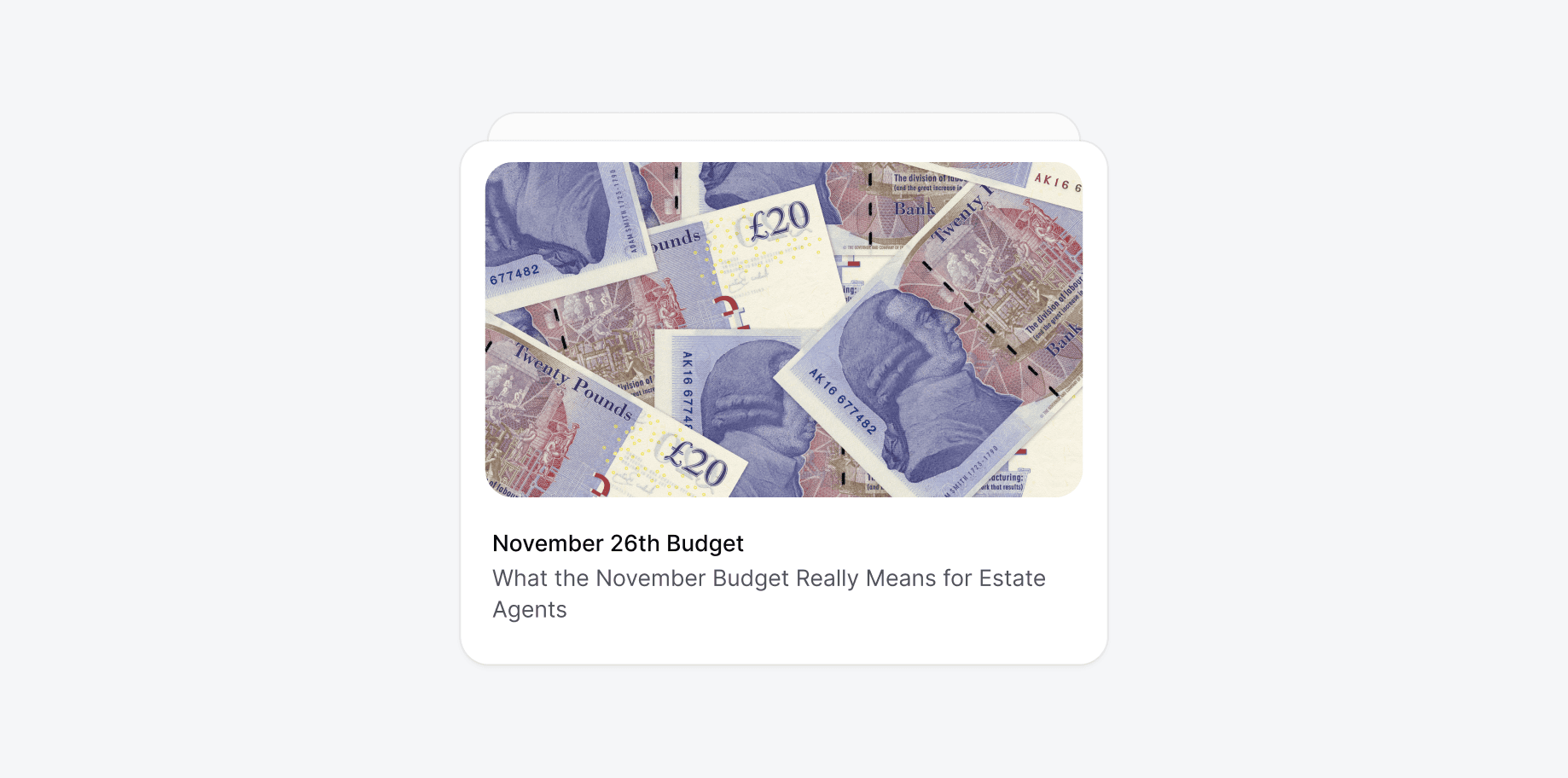
On 26 November, the Chancellor will deliver a Budget that has already cast a long shadow over the housing market.
Rightmove reports that average asking prices dropped 1.8% in the four weeks to 8 November, the sharpest fall for this time of year since 2012, with roughly a third of properties reducing their price at least once. Surveyors describe new instructions at a four-year low and talk about a market stuck in an Autumn Budget "holding pattern".
For estate agents, this mix of nervous sellers, hesitant buyers, and political uncertainty is already real. The interesting question is less "What will the Chancellor say?" and more "What kind of agency will be able to thrive in this environment?"
Increasingly, the answer comes back to productivity, and to how intelligently you use technology, including AI.
A slower, more complex market with higher expectations
The housing sector is bracing for potential changes to stamp duty and wider property taxation. Propertymark is urging the Chancellor to lower or modernise thresholds for first-time buyers, create permanent reliefs for downsizers, and avoid extending Capital Gains Tax to main residences, warning that doing so would further freeze mobility.
At the same time, commentators are debating ideas such as a recurring annual property tax on higher-value homes and rebalancing stamp duty against council tax. These reforms could significantly reshape buyer and seller behaviour over time.
Even if only a fraction of these ideas make it into the Budget, one thing is certain: clients will want clear, personalised explanations, fast.
Buyers will ask what tax changes mean for their budget and timing
Sellers will want to know whether to move now or wait
Landlords will ask whether to hold, sell, incorporate, or diversify
For a traditional agency model, that means hours of phone calls, emails, and ad-hoc calculators, just as transaction volumes are under pressure.
This is exactly where AI starts to look less like a futuristic add-on and more like a pragmatic response to a more demanding environment.
The Budget's core story is productivity, and AI is front and centre
In her scene-setter speech, Rachel Reeves was blunt: the UK's problem is not that people aren't working hard enough. It's that productivity is too low. She pointed explicitly to the lack of tools, from reliable broadband to "access to new technologies", as a core reason businesses are "putting in more and getting less out".
Alongside the Budget, we've already seen:
An AI Opportunities Action Plan aimed at using AI to "turbocharge growth and boost living standards"
A Digital Adoption Taskforce calling for targeted support to help SMEs adopt digital and AI tools
A small-business plan that promises digital adoption pilots and funding for SME tech skills
Proposals from industry groups for tax incentives linked directly to AI adoption, such as rebates on National Insurance where firms invest in AI or broadband
A commitment from the Chancellor to drive £14bn a year of public-sector efficiencies by 2029, partly by "driving efficiency through AI and digital technologies"
When the Treasury, regulators, and even the Bank of England are all pointing in the same direction (AI as a route to higher productivity), it's a strong signal. Estate agencies are exactly the kind of service-sector SMEs this agenda is aimed at.
What this means for estate agents in practice
Rather than focusing on any one tax change, agents can treat this Budget as a prompt to look hard at how work actually gets done in their businesses.
A few practical areas where AI already maps neatly onto the Budget's themes:
Explaining change to clients at scale, without losing the human tone
When rules move quickly, your value is partly in translation. AI can help turn technical Budget updates into clear, plain-English briefs for different audiences (first-time buyers, landlords, downsizers) in minutes rather than days. It can power conversational assistants on your site answering common questions about thresholds and timelines while you focus on complex cases, and generate tailored follow-up messages summarising the impact of policy changes on specific properties or portfolios.
The human still sets the tone and checks the nuance. AI simply does the heavy lifting.
Squeezed margins, sharper operations
With asking prices falling faster than usual and pipelines stalling, efficiency is no longer optional.
AI can quietly improve the economics of day-to-day agency work by automatically summarising call recordings and viewings into structured CRM notes, identifying hot versus cold leads based on behaviour and interactions, and drafting property descriptions and email campaigns that you then refine, reducing the "blank page" time.
This isn't about replacing negotiators. It's about making sure their time is spent negotiating, not transcribing or formatting.
Planning for different tax and demand scenarios
If the Budget changes stamp duty bands, landlord taxation, or support for first-time buyers, some segments of your market will move faster than others.
AI can help you run quick, scenario-based analyses on your own data, spot local micro-trends earlier, and adjust pricing and marketing strategies branch-by-branch rather than relying on "feel".
In other words, you can respond to the Budget as a data-driven business, not just a collection of branches reacting in isolation.
A Budget about more than numbers
Whatever precise mix of tax rises and incentives emerges on 26 November, the underlying story is already visible: a housing market that is nervous and price-sensitive, a government that expects growth to come from productivity and technology, and a regulatory environment that is beginning to make space for AI in planning and public services.
For estate agents, the real risk is not being caught out by one specific stamp duty tweak. It's failing to adapt to a world where productivity, data, and AI-driven processes become the norm.
The agencies that will be most resilient after this Budget are likely to be those that treat AI as a core part of how they communicate, analyse, and operate, not a side project. They'll use technology to free people up for genuinely human work: advising, negotiating, building trust. And they'll see the Budget not just as a tax event, but as another nudge towards running a more efficient, insight-led business.
That's the quiet opportunity in a noisy November.
Morgan Edmondson
Founder & CEO
Share